

Property Verification Checklist Before Buying Property in Bangalore
Updated: 28 August 2026
Buying a property involves several different checks: what rights the seller has, whether the seller can transfer them, what is recorded with public authorities, whether the proposed use and construction are authorised, and what financial or legal issues remain. A registered document, tax receipt, Khata record or project registration answers only part of that inquiry.
This checklist helps you organise documents and questions before a purchase. It is general information, not a title opinion, legal clearance or assurance that a particular property is safe to buy. The documents and searches needed depend on the property, its history, the seller and the applicable law.

Registration, title, ownership and property records: what is the difference?
Ownership describes the legal rights held in property; title is the legal basis supporting those rights. A buyer needs to examine how the seller acquired the claimed interest and whether it can validly be transferred. The sale deed must be read with the earlier title documents and the surrounding legal facts.
Registration records an instrument through the registration system. It is important to the legal operation of many property transactions, but registration is not a complete adjudication of the seller’s title. Under section 54 of the Transfer of Property Act, an agreement for sale does not, by itself, create an interest in or charge on the property. A promise to sell and a completed conveyance are different things. [Source 1]
Revenue and municipal records serve their own administrative purposes. They must be checked and reconciled with the title documents, but a change of name in those records is not, by itself, a transfer of ownership. The Supreme Court reiterated the limited effect of mutation entries in paragraph 35 of Mansoor Saheb v. Salima. [Source 2]
Building, planning and RERA records address further questions about permissions, project registration, disclosures and obligations. They must not be treated as interchangeable with a conveyance or an independent examination of title. [Source 3]
Start with the type of property
- Plot or land: identify the survey number, extent, boundaries, access and title history. Depending on the land, examine revenue entries, restrictions, conversion, land use, subdivision/layout approvals and acquisition or other proceedings.
- Resale apartment: examine the seller’s conveyance and authority, apartment and land-share descriptions, applicable building permissions, lender/security position, association records, dues and handover documents.
- Under-construction or new apartment: examine the landowner/developer relationship, exact project phase, applicable RERA registration and disclosures, sanctioned plans, agreement, payment terms and promised handover documentation. Verify any claimed exemption rather than assuming that every missing online record proves a violation.
The list below is not a requirement that every buyer must obtain every document in exactly the same form. Ask the reviewing advocate to identify what applies, what is missing and what further evidence is needed.

The 18-document property verification checklist
For every record, compare names, dates, property identifiers, extent, boundaries and the authority that issued or registered it. Record inconsistencies instead of assuming that similar descriptions refer to the same property.
|
Document |
Purpose |
Where it is obtained/verified |
What it establishes |
What it does NOT establish |
Common warning signs |
|---|---|---|---|---|---|
|
Registered sale deed/conveyance |
Identify the interest conveyed, parties and property schedule. |
Seller’s original; certified registration copy through Kaveri or the relevant Sub-Registrar. Compare both. |
The recorded conveyance and its terms; title effect depends on the transferor’s rights and legal validity. |
Registration alone does not establish an unbroken title, absence of fraud, approvals or freedom from all claims. |
Seller differs from transferee; inconsistent survey/site/flat numbers; missing schedules; unexplained alterations or missing original. |
|
Mother deed and complete title chain |
Trace how the seller and predecessors acquired the claimed interest. |
Seller/predecessor deeds and certified registration records; grant, partition or court records where relevant. |
Documentary links and the nature of successive transfers to be assessed together. |
A document called a “mother deed” is not an independent state guarantee. No universal search period makes every title safe. |
Missing link; inconsistent boundaries/extent; prior co-owner absent; restricted grant; unexplained subdivision. |
|
Seller authority and succession documents |
Check who can execute and whether further consents or parties are needed. |
Owner identity matched to deeds; relevant POA, corporate resolution, succession, partition, release or court documents with their issuers. |
Evidence relevant to capacity, authority and succession, subject to the applicable facts and law. |
A POA, death certificate, family tree or mutation entry alone is not a substitute for every required title/succession inquiry. |
Expired/revoked or narrow authority; deceased principal; omitted claimant/co-owner; conflicting inheritance accounts. |
|
Encumbrance certificate (EC) |
Search the registration record for transactions/encumbrances within defined parameters and dates. |
Kaveri/Sub-Registrar, using accurate identifiers and an advocate-selected period; compare underlying instruments. |
What the returned registration search records for that property/period. |
A nil EC is not proof of absolute title or absence of every unregistered interest, litigation, deposit-of-title-deeds security or indexing omission. |
Search begins too recently; wrong identifier; unexplained mortgage; transfer missing from chain; inconsistent names. |
|
Khata/eKhata or applicable municipal property record |
Match the municipal assessment/property identifier and recorded person to the transaction. |
The competent city corporation/revenue office and its current official service route; GBA portal as a starting point. |
The municipal record and assessment particulars that the issuing authority maintains. |
Not a conveyance, building regularisation certificate or conclusive title adjudication. A/B classification and draft/final eKhata need separate explanation. |
Draft document presented as final; PID/EPID mismatch; assessment area differs materially; unexplained name change. |
|
RTC/Pahani and mutation extracts, where applicable |
Examine land-record entries and changes for land under the revenue-record system. |
Bhoomi and competent revenue office; obtain historical mutation orders when relevant. |
Recorded revenue/possession/cultivation particulars and mutation history, subject to law and contrary evidence. |
Mutation does not itself confer title. RTC is not interchangeable with a municipal Khata or an apartment conveyance. |
Pending mutation dispute; disputed extent; government/grant entries; unexplained change of land classification. |
|
Property-tax receipts, assessment and arrears statement |
Check paid periods, property identity and outstanding municipal liability. |
Competent local authority’s assessment/collection records, matched to receipts. |
Payments and recorded dues for the identified assessment and periods. |
Payment does not prove ownership, authorised construction or that all utility/association liabilities are discharged. |
Wrong PID, missing years, unpaid demand, receipt not independently verifiable. |
|
Conversion order and land-use/layout approvals, where applicable |
Check whether the proposed use and subdivision have the necessary legal basis. |
Competent revenue/planning authority; original order, conditions and sanctioned layout, independently verified. |
The permission actually granted, extent, conditions and approved use/layout. |
Conversion is not title; a layout approval is not an individual building sanction; neither excuses unmet conditions. |
Approval for a different survey number/use; conditional approval treated as final; restricted land or acquisition concerns. |
|
Sanctioned building plan and revisions |
Compare the proposed/existing building to the authority’s permission. |
Competent planning/building authority; compare with RERA disclosures and qualified architect/engineer inspection. |
Approved design, use and conditions within the sanction’s scope. |
A builder’s brochure or plan stamp does not prove actual conformity, structural soundness, title or permission to occupy. |
Extra floors, altered setbacks/use, missing revision approval, different tower or phase. |
|
Completion certificate, where applicable |
Check the authority’s completion certification and its scope. |
Relevant competent authority; verify document number, building/phase and conditions. |
Completion certification as defined by the applicable law and the particular certificate. |
Not automatically the same as an occupancy certificate or a guarantee against all defects. |
Self-issued builder letter substituted; different phase; unresolved conditions; unclear issuing authority. |
|
Occupancy certificate (OC), where applicable |
Check permission to occupy the relevant building or part. |
Relevant competent authority; compare exact tower/floor/phase and plan references. |
Occupation permission within the certificate’s scope under applicable law. |
Not proof of title, a full-project permission when only partial, or an independent structural/quality warranty. |
Application receipt presented as approval; partial OC claimed as full; flat/floor excluded. |
|
RERA project record and disclosed documents |
Check registration/status, project phase, promoter disclosures, changes and orders. |
Karnataka RERA’s project-status and orders services; verify the precise registration number and phase. |
The regulator’s available registration/status record and disclosed material. |
Registration is not title insurance or a guarantee of completion. An absent search result is not by itself proof that registration was legally required and breached. |
Different phase/name; lapsed/revoked status; missing updates; undisclosed charge; claimed exemption without evidence. |
|
Agreement for sale, allotment and payment schedule |
Compare promised unit, price, conditions, possession and remedies. |
Promoter/seller documents; registered copy where applicable; compare RERA disclosures and the governing rules. |
Contractual commitments and recorded payments, subject to enforceability and applicable statutory rights. |
An agreement to sell alone does not transfer ownership. A payment receipt is not conveyance or unconditional refund entitlement. |
Oral assurances contradict text; vague possession date; altered unit/area; advance or cancellation terms needing review. |
|
Apartment deed/UDS, declaration and common-area documents |
Identify the apartment interest, land share and common-area rights claimed. |
Registered conveyance and relevant declaration/deed records; seller, developer, association and Sub-Registrar. Check applicability of the Karnataka apartment framework. |
The rights and shares actually documented, interpreted with applicable law and sanctioned project records. |
Association membership, maintenance payment or a brochure does not by itself convey land/common-area ownership. |
Missing or inconsistent UDS; flat schedule mismatch; reserved common area sold as private; missing landowner linkage. |
|
Development agreement, POA and allocation documents |
Verify developer/landowner authority and entitlement to sell the specific unit. |
Landowner/developer; registered records where applicable; compare allocation and subsequent changes. |
The documented development/sale authority and allocation, subject to validity and continuing effect. |
Does not by itself establish clean underlying title or that every unit is available for sale. |
Seller’s allocation excludes the flat; revoked authority; landowner dispute; overlapping allotments. |
|
Association registration, bye-laws, handover and dues records |
Examine governance, maintenance obligations and records handed over. |
Association and competent registrar; promoter’s handover records; verify issuer and applicable legal form. |
The documented governance arrangement, accounts/dues and handover evidence. |
Registration of an association alone does not establish conveyance, completion of all works or validity of every levy. |
No identifiable governing framework; missing minutes/accounts; disputed handover; incomplete common-area documentation. |
|
Mortgage/security papers, lender payoff and release documents |
Identify finance/security and agree a verifiable closing/release sequence. |
Seller and lender through independently verified contact; relevant registration/charge records; CERSAI where relevant and lawfully accessible. |
The particular lender’s documented security, outstanding amount and completed release/satisfaction steps. |
Loan sanction, a seller’s assurance or a generic NOC does not prove all charges are extinguished or all originals returned. |
Missing original deeds; payment to an unrelated account; release promised after unrestricted payment; unsatisfied charge. |
|
Litigation searches, pleadings, orders and seller disclosures |
Identify disputes, injunctions and claims relevant to the seller/property/project. |
Relevant courts/eCourts, Karnataka High Court, revenue/planning authorities and Karnataka RERA; certified orders where needed. |
Located proceedings and the actual scope/current status of their orders. |
“No result” is not a comprehensive no-litigation certificate; a disposed case may still have appeals or operative directions. |
Identity variants ignored; property schedule mismatch; injunction/attachment; pending appeal; inconsistent seller declaration. |
How to use the checklist: a buyer’s due-diligence sequence
1. Identify the property and the transaction
Make one reference sheet containing the seller’s name, property type, address, survey/site/flat number, municipal identifier where applicable, extent, boundaries and project/tower/phase. Record whether the transaction is a developer sale, resale, landowner allocation or another arrangement. Ask the advocate to resolve identifier differences at the beginning.
2. Collect the documents and record what is missing
Request readable copies of the current conveyance, earlier title documents, seller-authority papers and relevant public records. Arrange them chronologically. Note who holds the originals; do not assume that a scanned copy explains why an original is missing. A missing record should remain an open issue until the advocate determines its significance and the appropriate verification route.
3. Reconstruct the title and seller’s authority
Trace the chain to an appropriate starting point selected for the property’s history. Review intervening sales, inheritance, partition, release, grants or court orders as applicable. Where an attorney, company, developer or other representative will sign, check authority for the particular transaction and whether it remains effective. No fixed search period or document count guarantees sufficient title review.
4. Verify public records independently
Compare registration copies and EC results with the deeds. Check the relevant municipal/revenue records and the orders behind unexplained changes. Record the identifiers, period and date used for each search. A nil result or an incomplete digital record is a reason to examine the search scope, not to issue a blanket clearance.
5. Check land use, plans and the actual property
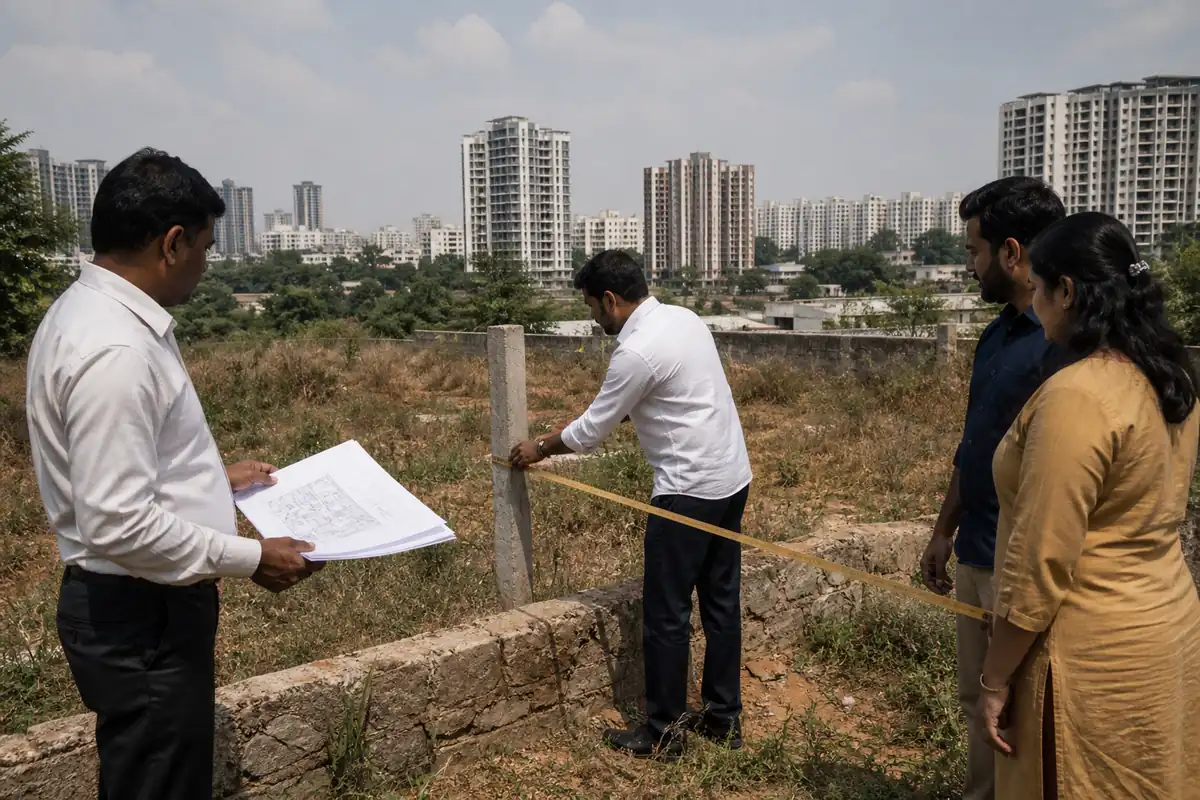
Identify the competent authority and the permissions relevant to the property. Compare approved use, layout and building plans with what is being sold and what exists on site. An advocate’s document review does not replace an appropriately qualified surveyor’s or architect/engineer’s work on boundaries, construction or physical conformity.
6. Check project and apartment-specific documents
For a relevant project, match the RERA record to the correct promoter, registration number and phase. Read the available disclosures and orders. For an apartment, reconcile its conveyance, land share, common-area documentation, applicable certificates and association/management records. Check the legal framework applicable to that building rather than assuming that every association follows the same route. [Source 3]
7. Resolve finance, dues and dispute questions
Obtain the lender’s current written information where security exists. Ask the advocate and lender to settle the required payoff, release, satisfaction and original-document arrangements before agreeing to the closing sequence. Check relevant taxes, other dues, seller disclosures and located legal proceedings. Search results should be assessed against the property description and current orders.
8. Review the agreement before making commitments
Have the transaction documents reviewed before signing or making a material payment. Check the property description, price and payment stages, conditions to be met, document delivery, possession arrangements and remedies if the transaction does not proceed. Promoter transactions may engage section 13 of RERA; do not assume that a standard booking form or the seller’s preferred advance terms comply. [Source 3]
9. Close only on a reviewed, documented basis
Before completion, review outstanding issues and any changes since the searches were made. The relevant professionals should identify what must be completed before, at and after execution/registration, including payment evidence, possession, original documents and any release or follow-up record changes. Do not treat registration day as proof that all earlier issues have disappeared.
Warning signs that deserve further investigation
A warning sign is a reason to ask for evidence and professional assessment; it is not, on its own, proof of fraud or illegality.
- Seller, predecessor or property details do not match across the deed, EC, municipal/revenue entries or project documents.
- The seller cannot explain a missing title document, a break in the chain or the location of originals.
- A family tree, POA, tax receipt or mutation entry is offered as the sole answer to an unresolved title or authority question.
- A building-plan application, developer letter or partial certificate is presented as an approval covering the entire property.
- Project registration, phase, land share, unit allocation or common-area documents do not correspond to the unit being sold.
- A mortgage is to be cleared through an unverified contact or payment account, or the release/original-document arrangements remain unclear.
- A pending injunction, attachment, appeal or authority notice is dismissed without examining the actual documents and current status.
- The buyer is pressured to pay before reviewing documents, independent verification is discouraged, or promised corrections are not documented.
Bangalore and Karnataka official starting points
Use official resources to identify the correct service and issuing authority. Some services may require login, verification, a fee or an in-person process. Do not assume that an online page is a substitute for the necessary certified record or professional review.
|
Resource |
What to use it for |
|---|---|
|
Locate registration, EC and certified-copy services; confirm the correct record/search parameters. |
|
|
Bengaluru Urban Bhoomi information and Karnataka land-record portal |
Identify relevant RTC/mutation and land-record services. |
|
Competent Bengaluru municipal authority / property-record office |
Start with current jurisdiction and official municipal/eKhata service routes. Confirm the competent corporation and actual issuing office for the property. |
|
Locate project information, applicable disclosures and published orders; distinguish project phases. |
|
|
Locate official departmental information relevant to conversion, land acquisition and revenue proceedings. |
Court and authority searches: ask the advocate which courts, tribunals, revenue/planning authorities and other records should be checked for the particular seller and property. The right scope may extend beyond a single district, portal or spelling of a party’s name.
Printable buyer worksheet
Select the worksheet below and use your browser’s Print selection option, where available. Choose landscape for the reference matrix. Check the preview before printing; keep the source page URL and the limitations with your notes.
Use one worksheet for each property. Write “not applicable: reason recorded” where the reviewing advocate determines that a check does not apply; do not treat a blank field as completion.
Property type / address / identifiers: ____________________
Seller / developer / phase where applicable: ____________________
Documents received on: ____________________
Originals held by: ____________________
Advocate reviewing the transaction: ____________________
|
Check group |
Documents/source/date checked |
Open question or missing evidence |
Next action / person responsible |
|---|---|---|---|
|
Seller and title history |
|||
|
Registration / EC search |
|||
|
Municipal / revenue / taxes |
|||
|
Land use / layout / building plans |
|||
|
OC / completion / project records |
|||
|
Apartment / land share / association |
|||
|
Lender / security / original documents |
|||
|
Litigation / notices / current orders |
|||
|
Agreement / payments / closing conditions |
Source page: https://ealegal.in/property-verification-checklist-bangalore/
Issues still unresolved: ____________________
Date on which records should be refreshed: ____________________
Transaction review notes and limitations: ____________________
Completing this worksheet does not certify title or replace an advocate’s assessment of the documents, searches and facts.
Frequently asked questions
Sources and limitations
- Transfer of Property Act, 1882 – India Code: section 54, read with relevant transfer, seller-obligation and mortgage provisions for the issue being considered.
- Mansoor Saheb v. Salima, 2024 INSC 1006 – Supreme Court: paragraph 35 on mutation entries. This reference does not import the case’s distinct personal-law facts into every property transaction.
- Real Estate (Regulation and Development) Act, 2016 – Karnataka RERA: certificate definitions in sections 2(q) and 2(zf); registration/disclosures in sections 3–4; promoter duties, agreements, plans and conveyance in sections 11, 13–14 and 17; allottee rights in section 19, as applicable.
- Suraj Lamp & Industries Pvt. Ltd. v. State of Haryana, judgment dated 11 October 2011 – Supreme Court: the distinction between an SA/GPA/Will arrangement and conveyance, while preserving genuine authority for an attorney to execute a conveyance for the owner.
Official sources and search records should be read in the version applicable to the transaction. Local law, amendments, the property history and case-specific facts may change the analysis.
How EA Legal can help with property verification
EA Legal reviews property documents and transaction questions. Read about property verification and related legal services or contact EA Legal with the property type, location and available document index.