Mutual Consent Divorce Process in Bangalore
When both spouses freely agree that the marriage should end and settle every connected issue such as division of joint assets, child custody, visitation rights, and alimony, they can jointly ask the Family Court for divorce by mutual consent. The mutual consent divorce process in Bangalore generally involves a joint petition, an application seeking waiver of the 6-month cooling period, reference to the Karnataka Mediation Centre, and then a decree.
For spouses governed by the Hindu Marriage Act, 1955, Section 13B ordinarily requires the parties to have lived separately for at least one year and to mutually agree that they are unable to live together. Importantly, “living separately” does not necessarily mean that the parties must be physically residing at different addresses. It can also refer to the parties having ceased to live as husband and wife, even if they continue to reside under the same roof, depending on the facts of the case.

What does mutual consent divorce require?
Mutual consent requires a continuing, voluntary agreement to dissolve the marriage and a workable settlement of finances, children, property, proceedings, and future claims.
Both spouses must consent throughout
The petition is joint. Both spouses normally confirm the settlement and their consent before the court at the first and second motions. Either spouse may withdraw consent before the decree. A signed memorandum is strong evidence of terms, but it cannot authorise the court to dissolve the marriage after statutory consent disappears.
The parties must meet the separation requirement
Under section 13B of the Hindu Marriage Act, the spouses must have been living separately for one year or more, have been unable to live together, and mutually agree to dissolution. “Living separately” describes the marital relationship and not only different addresses. Facts such as separate lives under one roof require careful explanation.
The first-year bar after marriage must be considered
Section 14 of the Hindu Marriage Act ordinarily prevents a divorce petition within one year of marriage. The court may permit an earlier petition only on the statutory ground of exceptional hardship to the petitioner or exceptional depravity by the respondent. This exception is narrow and fact-specific.
Mutual divorce works only when consent is informed, voluntary, and sustained until the decree.
Which law applies to mutual divorce in Bangalore?
The applicable provision depends on how and under which law the marriage was solemnised, not simply on where the spouses now live.
|
Marriage framework |
Mutual-consent provision |
Core point |
|---|---|---|
|
Hindu Marriage Act, 1955 |
Section 13B |
One-year separation condition and joint motions, subject to law on waiver. |
|
Special Marriage Act, 1954 |
Section 28 |
Mutual divorce for marriages governed by the Act, with its own statutory wording. |
|
Divorce Act, 1869 |
Section 10A |
Mutual dissolution for Christian marriages; statutory wording and applicable Karnataka case law need case-specific review. |
|
Parsi Marriage and Divorce Act, 1936 |
Section 32B |
Mutual consent ground for marriages governed by the Act. |
Muslim marriages may be dissolved through personal-law customary procedure. Section 13B of the Hindu Marriage Act does not apply to every couple. We first verify the marriage documents, registration details, applicable personal law, and any previous proceedings before advising on the appropriate legal process.
The correct statute controls the conditions, court, and language of the petition.
What is the mutual consent divorce process in Bangalore?
The process of obtaining a divorce by mutual consent involves several stages, from the initial preparation of the petition and waiver application to obtaining the certified copy of the final Divorce Decree. A well-prepared petition and a clear understanding between the parties can make the process more structured and efficient.
Stage 1 – Drafting and Filing of Petition and Waiver Application
The process begins with the preparation of the Joint Petition for Divorce by Mutual Consent, setting out the relevant details of the marriage, children born in the marriage, separation, jurisdiction, and the terms agreed between the parties. The Petition should clearly record all important facts, including maintenance or alimony, exchange of jewellery and personal belongings. It should also contain the division of property and other financial arrangements, pending legal proceedings, child custody or residence, visitation, education and medical expenses. Where appropriate, a Waiver Application is also prepared and filed seeking exemption from the statutory six-month waiting period. The possibility of seeking waiver is subject to the facts and circumstances of each case. The Supreme Court, in Amardeep Singh v Harveen Kaur, (2017) 8 SCC 746, held that the six-month period under Section 13B(2) is directory and may be waived by the Court in appropriate cases, subject to the requirements laid down by the Court.
Stage 2 – Registration of Case and Hearing on the Waiver Application
The Court registers the case, assigns an “M.C.” number and thereafter hears the Waiver Application and considers whether the circumstances justify dispensing with the six-month waiting period. If the waiver is allowed, the matter is referred to the Karnataka Mediation Centre without waiting for the full six-month period. If the waiver is not allowed, the parties are required to complete the statutory six-month waiting period, after which the matter is referred to the Karnataka Mediation Centre. The waiver is not automatic and depends on the facts of the particular case and the Court’s satisfaction.
Stage 3 – Mediation and Preparation of Settlement Agreement
The parties then attend mediation before the Karnataka Mediation Centre. The purpose of this stage is to ensure that all terms between the parties are clearly understood and recorded. Where the parties have already agreed upon their terms, the same are discussed and formally recorded in a Mediation or Settlement Agreement. The agreement clearly specifies the obligations of each party and the manner and timeline for completing the agreed terms. This helps avoid ambiguity and provides clarity when the settlement is subsequently placed before the Court.
Stage 4 – Confirmation Before Court and Passing of Divorce Decree
The Mediation or Settlement Agreement is thereafter placed before the Court. Both parties appear before the Court and confirm the terms of the settlement and their consent. Once the Court is satisfied that the consent is voluntary and that the parties continue to seek dissolution of the marriage by mutual consent, the Court proceeds to pass the Divorce Decree.
Stage 5 – Certified Copy of the Divorce Decree
After the Divorce Decree is passed, an application is made for the certified copy of the decree. Once the certified copy is issued by the Court, it is collected and handed over to the client for their records and for use in any future legal, administrative or personal requirements. The certified copy generally takes about 30 days, subject to the Court’s administrative process. Thus, with proper preparation, clear settlement terms and timely compliance at each stage, the mutual consent divorce process can be handled in a structured and efficient manner.
What documents are required for mutual divorce?
- Original Marriage Invitation Card
- Original Marriage Photographs
- Certified Copy of the Registered Marriage Certificate, if the marriage is registered.
- Attested Copies of Government ID or Address Proof of both parties, such as Aadhaar Card, Voter ID, Driving Licence, Bank Passbook, Gas Bill, Electricity Bill or Passport containing a Bangalore address.
How Will Money, Property and Maintenance Be Settled?
In a mutual consent divorce, the parties have the flexibility to mutually agree on the financial and other terms of their separation. We will discuss these aspects with both parties and ensure that the agreed terms are properly recorded in the Settlement Agreement, with clear obligations and timelines wherever required.

Maintenance and Alimony
The parties may mutually agree on lump-sum alimony, instalments, periodic maintenance, or no maintenance or alimony, depending on their circumstances and understanding. We will ensure that the agreed arrangement is clearly recorded so that there is no ambiguity regarding the financial obligations of either party.
Property, Jewellery and Belongings
The settlement will cover the mutually agreed arrangements relating to immovable and movable properties, jewellery, personal belongings, bank accounts, investments, vehicles and other assets, wherever applicable. The parties can decide which assets are to be retained, transferred, divided or returned. Where any separate document, registration, transfer or release is required, the same will be specifically addressed in the settlement.
Payment and Other Financial Arrangements
We will also ensure that the settlement clearly records the amount to be paid, the mode of payment and the agreed timeline or stage for payment. This may include payments linked to the first motion, mediation, second motion or passing of the Divorce Decree. Any other agreed financial arrangements, liabilities or pending claims between the parties will also be addressed.
Complete Settlement
Our objective is to ensure that all matters between the parties are comprehensively addressed before the settlement is finalised. This provides clarity to both spouses and helps minimise the possibility of further financial, property or other disputes after the Divorce Decree.
How Are Child Custody and Parenting Terms Handled?
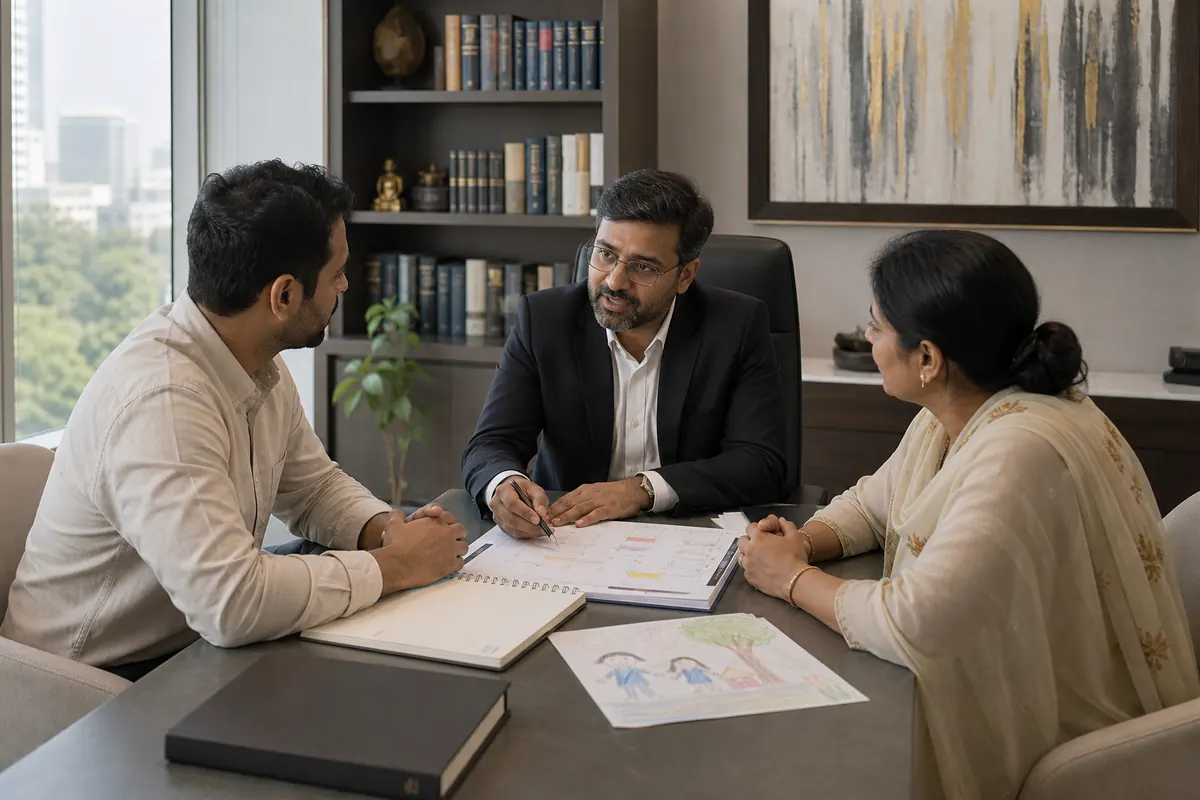
In a mutual consent divorce, the parties can mutually agree upon the custody and visitation arrangements for their children. We will discuss and record the agreed terms clearly in the Settlement Agreement, including which parent will have custody and the visitation rights of the other parent.
Custody and Visitation
The settlement will clearly state that one parent will retain custody of the child, while the other parent will have agreed visitation and access rights. The parties can also agree upon the manner, timing and duration of visitation, including holidays, weekends, telephone or video calls, travel and other arrangements, as applicable.
Education, Marriage and Other Expenses
The parties can mutually agree on how expenses relating to the child will be met, including education, medical expenses, extracurricular activities, marriage and other major expenses. The Settlement Agreement will clearly record the respective financial responsibilities of both parents.
Clear Parenting Arrangement
Our role is to ensure that the agreed custody, visitation and financial arrangements concerning the child are clearly and comprehensively recorded, so that both parents have a clear understanding of their respective rights and responsibilities following the divorce.
How Long Does Mutual Consent Divorce Take in Bangalore?
The timeline for a mutual consent divorce in Bangalore depends on the facts of the case, the Court’s schedule, whether a waiver of the waiting period is granted, and completion of the required mediation and settlement formalities. Where the waiver is allowed and both parties have agreed on all terms, the matter can generally be completed relatively quickly. In a straightforward case, we generally expect the Divorce Decree to be passed within about 15 days to one month, subject to the Court’s availability and completion of all required formalities.
If the waiver is not granted, the statutory six-month waiting period will apply before the matter can proceed further. The overall timeline may also be affected by filing scrutiny, mediation, compliance with settlement terms and the Court’s listing schedule. Accordingly, while we can provide a stage-wise estimate based on the circumstances of the case, the exact timeline is ultimately subject to the Court’s process and cannot be guaranteed.
What Can Delay a Mutual Divorce?
A mutual consent divorce is generally a straightforward process when both parties remain available and continue to comply with the agreed terms. However, certain practical circumstances may cause delay, including:
- Non-appearance of either party on the date fixed by the Court.
- Change or withdrawal of consent by either party.
- Non-compliance with agreed settlement terms or delay in completing required formalities by either party.
- A judge’s leave or transfer resulting in the matter being listed on a later date.
- Non-availability of mediators at the Karnataka Mediation Centre, which may result in the mediation being scheduled for a later date.
These are generally matters beyond the parties’ direct control. We will monitor the case and Court schedule and take the necessary steps to ensure that the matter progresses at the earliest possible opportunity.
Frequently asked questions
These answers cover frequent practical concerns, but personal law, court jurisdiction, children, finances, and pending cases can change the advice.
How EA Legal can help
At EA Legal, we make the mutual consent divorce process structured, transparent and stress-free. From identifying the correct law and Family Court to drafting the Joint Petition, Waiver Application and Settlement Agreement, we handle each stage with care and precision. Our focus is on clear documentation, practical timelines and protecting your interests, while keeping the process respectful for both parties.
Ready to take the next step? Contact EA Legal with your marriage details, date of marriage, separation date, children’s details, pending cases and agreed settlement terms. Let us help you move forward with clarity, confidence and closure.
This guide states the position as of August 2026 and is general information. Personal law, court practice, and individual facts can change the correct route.